How to Choose the Right Boardroom Table Size for Your Office
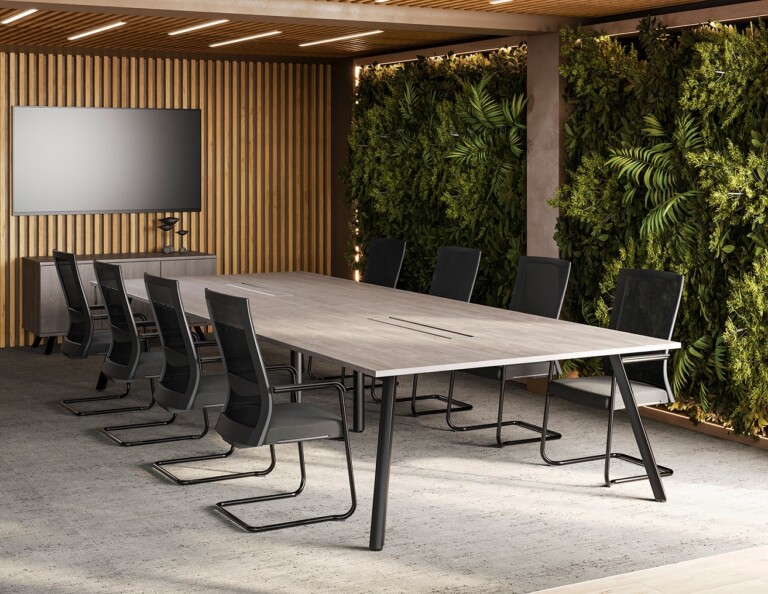
A boardroom table is often the centrepiece of a company’s meeting space. It’s where important decisions are made, clients are welcomed and teams come together to discuss ideas. However, choosing the wrong table size can quickly make even a well-designed boardroom feel cramped or impractical.
Too small, and employees may struggle with limited elbow room, laptops and paperwork. Too large, and the table can dominate the room, leaving insufficient space for chairs, storage and movement.
Finding the right balance is essential. Whether you’re furnishing a compact meeting room for four people or a large executive boardroom seating 16 or more, the size, shape and configuration of your table will influence how comfortably the space functions.
In this guide, we’ll explain standard boardroom table sizes, how much space to allow per person, the clearance needed around your table and how to select the best shape for your office.
What Is the Standard Size of a Boardroom Table?
There isn’t one standard boardroom table size. Boardroom tables are manufactured in various lengths and widths to accommodate different numbers of people, room dimensions and meeting requirements.
Smaller meeting tables may measure around 1200–1800mm in length, while larger conference tables can extend beyond 4000mm. Some modular and bespoke boardroom systems can be manufactured in considerably longer configurations.
The ideal size depends on several factors:
- Seating capacity: How many people regularly attend meetings?
- Room dimensions: How much space is available once doors, cupboards and other furniture are considered?
- Table shape: Rectangular, oval, round and barrel-shaped tables accommodate seating differently.
- Chair dimensions: Wider executive chairs need more space than compact meeting chairs.
- Technology: Laptops, conferencing equipment and integrated power modules may influence table dimensions.
- Meeting requirements: Formal presentations and lengthy meetings often benefit from more generous personal space.
As a general planning guideline, allowing approximately 600–750mm of table edge per person is a useful starting point. For executive boardrooms with larger chairs, 750–900mm per person may provide greater comfort.
These measurements are guidelines rather than fixed requirements, and the final seating capacity should always be checked against the actual table design.
Boardroom Table Size Guide: How Many People Can You Seat?
One of the easiest ways to narrow down your options is to start with the number of people you need to accommodate.
The table below provides indicative dimensions for common rectangular and barrel-shaped boardroom tables.
| Seating Capacity | Suggested Table Length | Typical Table Width |
|---|---|---|
| 4 people | 1200–1600mm | 800–1000mm |
| 6 people | 1800–2200mm | 900–1200mm |
| 8 people | 2400–2800mm | 1000–1200mm |
| 10 people | 3000–3400mm | 1000–1400mm |
| 12 people | 3600–4200mm | 1200–1400mm |
| 16 people | 4800–5600mm | 1200–1600mm |
These are illustrative planning ranges, not guaranteed capacities or dimensions of specific LOF products. Actual seating depends on the table shape, leg positions, chair widths and whether the ends of the table are used.
For example, an eight-person rectangular boardroom table might accommodate three people along each side and one person at either end. However, certain table bases or leg arrangements may prevent the ends from being used comfortably.
For businesses comparing different options, our meeting and boardroom tables include designs suitable for both compact meeting spaces and larger executive boardrooms.
How Much Space Do You Need Per Person at a Boardroom Table?
Seating capacity should never be calculated from table length alone. Employees and visitors need enough room to sit comfortably, move their chairs and use laptops or other meeting equipment.
A useful starting point is to allow 600–750mm of usable table edge per person.
However, the amount of space required will depend on the type of seating and how the boardroom is used.
Allowing for Different Chair Sizes
Boardroom chairs vary considerably in width.
Compact meeting chairs may occupy less space than executive chairs with padded arms, high backs or wider seat frames.
If you choose larger chairs, you may need to reduce the number of people seated around the table or select a longer model.
For example, six chairs each requiring approximately 750mm of usable edge space need substantially more room than six compact chairs arranged at 600mm intervals.
Allowing Space for Laptops and Paperwork
Modern boardrooms frequently accommodate laptops, documents, notebooks, refreshments and mobile devices.
Providing sufficient table depth is particularly important when people sit opposite one another.
A narrow table may accommodate the required number of chairs but leave limited space for equipment in the centre.
For meetings where laptops and paperwork are used regularly, selecting a wider tabletop can make the space more practical.
Considering Table Legs and Supports
The position of table legs can affect the number of people who can sit comfortably.
Some tables use legs positioned towards the outer corners, while others feature central columns or inset frames.
Central supports can provide additional legroom along the edges of a table, although the exact benefit depends on the design.
Before purchasing, check the manufacturer’s drawings to confirm that every proposed seating position is usable.
How Much Clearance Should You Leave Around a Boardroom Table?
One of the most common mistakes when choosing a boardroom table is focusing entirely on the tabletop dimensions without allowing enough space around it.
Employees need room to pull chairs away from the table, stand up and move around without disturbing other people.
As an initial planning allowance, approximately 900–1200mm between the table edge and surrounding walls or furniture may be useful, with more generous space where people need to walk behind occupied chairs.
| Clearance | Practical Consideration |
|---|---|
| 750mm | May be restrictive; generally unsuitable where people need to pass behind occupied chairs |
| 900mm | Potential starting point for less heavily used areas, subject to chair dimensions |
| 1000–1200mm | More generous allowance for chair movement and access |
| Over 1200mm | May be preferable for busy circulation routes and larger boardrooms |
These figures are indicative furniture-planning allowances, not statutory minimums. Escape routes, accessible circulation and other requirements must be assessed for the particular building and layout.
A clearance that works when chairs are pushed under the table may become restrictive once everyone is seated.
Door openings, wheelchair access, storage units and presentation equipment must also be considered.
For businesses creating a new meeting room, our office space planning service can help identify suitable furniture arrangements before purchasing.
How to Calculate the Right Boardroom Table Size for Your Room
Before selecting a boardroom table, measure the available room dimensions and work out how much space can realistically be allocated to the furniture.
A simple way to estimate the space required is to add your planned clearance on both sides of the table.
Room length required = Table length + Clearance at both ends
Room width required = Table width + Clearance on both sides
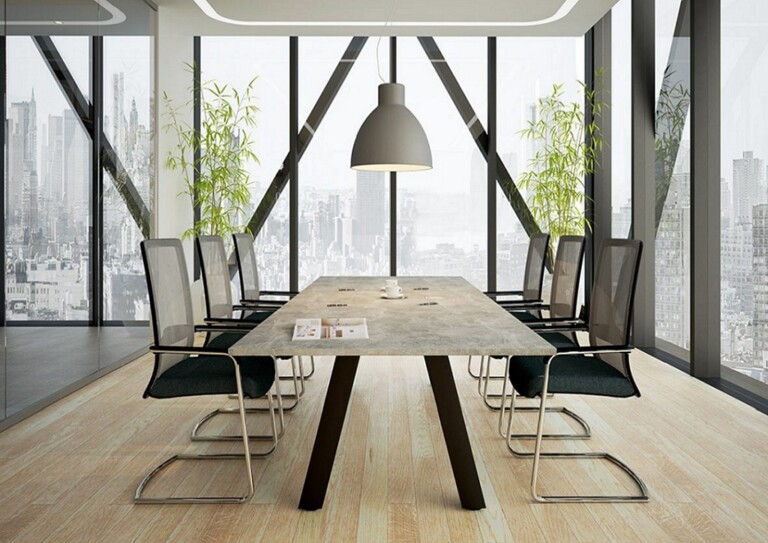
Which Boardroom Table Shape Is Best for Your Office?
The shape of your boardroom table can influence seating capacity, movement around the room and how people interact during meetings.
Different shapes work better in different environments, so the choice should reflect both practical requirements and the appearance you want to achieve.
Rectangular Boardroom Tables
Rectangular tables are among the most common choices for traditional boardrooms and conference rooms.
Their straight edges provide a structured seating arrangement, making them particularly suitable for formal meetings, presentations and executive discussions.
They can also be positioned efficiently within rectangular rooms.
Advantages of rectangular tables:
- Suitable for larger meeting groups.
- Make efficient use of long, rectangular rooms.
- Provide a clear seating arrangement.
- Available in a wide range of lengths and widths.
- Can accommodate integrated power and cable management.
One option within our range is the Force boardroom table, which features a substantial 100mm box-section leg frame and is available in different sizes and finishes.
Oval and Barrel-Shaped Boardroom Tables
Oval and barrel-shaped tables provide an alternative to traditional rectangular designs.
Their curved edges create a softer appearance and can make it easier for attendees to see one another during discussions.
Barrel-shaped tables are particularly popular in executive boardrooms, where businesses want a substantial table without the angular appearance of a traditional rectangle.
However, their curved profiles mean the usable seating edge should be checked carefully.
The Aerofoil meeting table, available through our boardroom furniture range, offers a traditional barrel-shaped design with central leg supports to provide additional legroom.
Round Boardroom Tables
Round tables can be an excellent choice for smaller meeting rooms and collaborative spaces.
Because there is no clearly defined head of the table, everyone can face one another, which can help create a less formal atmosphere.
Round tables are particularly suitable for:
- Small team meetings.
- Informal client discussions.
- Interview rooms.
- Collaborative working areas.
- Compact meeting spaces.
However, very large round tables can become impractical because the distance between people sitting opposite one another increases significantly.
For this reason, round tables are generally more appropriate for smaller groups than large executive boardrooms.
Modular and Flexible Meeting Tables
Not every business needs a permanently configured boardroom.
Some organisations require meeting spaces that can accommodate presentations, training sessions, interviews and larger group discussions.
Modular tables can provide the flexibility to rearrange a room for different purposes.
Depending on the chosen system, individual tables may be grouped together, separated or moved into storage.
Our meeting furniture collection includes flexible solutions such as Fliptop and Flexi tables, which can be arranged to suit changing workplace requirements.
Boardroom Table Shapes Compared
| Table Shape | Best Suited For | Main Advantage | Consideration |
|---|---|---|---|
| Rectangular | Traditional boardrooms and formal meetings | Efficient seating along straight edges | Can feel formal and structured |
| Oval | Executive meetings and collaborative discussions | Softer appearance and good sightlines | Curved ends may reduce seating flexibility |
| Barrel-shaped | Premium boardrooms | Distinctive appearance and spacious centre | Capacity depends on the shape |
| Round | Smaller meeting rooms | Encourages face-to-face discussion | Less practical for large groups |
| Modular | Training and multipurpose rooms | Can be reconfigured | Requires suitable storage and management |
When comparing different shapes, always consider the complete room layout rather than the table in isolation.
How to Choose the Right Boardroom Table for a Small Meeting Room
Smaller meeting rooms can be challenging to furnish because every centimetre matters.
A table that looks compact in a showroom may feel considerably larger once chairs and other furniture are added.
For rooms accommodating four to six people, a smaller rectangular, round or oval table may provide sufficient seating without dominating the space.
To maximise the available room, consider:
- Choosing a table with a central or inset leg arrangement.
- Avoiding unnecessarily wide executive chairs.
- Using wall-mounted screens instead of freestanding presentation equipment.
- Selecting compact storage or removing furniture that isn’t essential.
- Checking that doors can open fully when chairs are occupied.
- Considering modular furniture if the room has multiple uses.
For particularly restricted rooms, it may be more practical to reduce the seating capacity rather than choosing a larger table that makes movement difficult.
What Size Boardroom Table Do You Need for 8, 10 or 12 People?
Eight, ten and twelve-person boardroom tables are common requirements for businesses that regularly host departmental meetings, management discussions and client presentations.
Although there is some overlap between table sizes, each arrangement has different space requirements.
Eight-Person Boardroom Table
An eight-person table will often be approximately 2400–2800mm long, depending on the design.
This size can work well in medium-sized meeting rooms where employees need space for laptops, documents and refreshments.
A rectangular or barrel-shaped table is often a practical choice.
Ten-Person Boardroom Table
For ten people, a table approximately 3000–3400mm long may be an appropriate starting point.
At this size, chair width and table supports become increasingly important.
If your business regularly hosts longer meetings, choosing a larger table within the available range may provide a more comfortable arrangement.
Twelve-Person Boardroom Table
Twelve-person boardroom tables commonly require a length of approximately 3600–4200mm, although designs and seating configurations vary.
Larger tables may benefit from additional cable management, multiple power access points and carefully positioned video-conferencing equipment.
The room should also provide sufficient space for people to move around the table without disrupting those already seated.
For very large meeting spaces, modular or bespoke furniture may be more suitable than a standard table.
Should You Choose a Standard or Bespoke Boardroom Table?
Standard boardroom tables are available in a wide variety of sizes, finishes and configurations, making them suitable for most office environments.
However, some spaces require a more tailored solution.
A bespoke boardroom table may be worth considering when:
- The room has unusual dimensions or architectural features.
- A specific seating capacity cannot be achieved with standard products.
- The table needs to complement an established interior design.
- Specialist power, data or audio-visual equipment must be integrated.
- The business wants a distinctive executive boardroom.
- Particular materials, finishes or dimensions are required.
Although a bespoke table may involve additional design and manufacturing costs, it can provide a solution tailored to the room rather than forcing the room to accommodate an unsuitable standard product.
At Leicester Office Furnishers, we can source and arrange bespoke office furniture to meet specific requirements, including custom boardroom tables.
Real Boardroom Installations by Leicester Office Furnishers
The best boardroom table is one that responds to the needs of the business and the physical characteristics of the room.
At Leicester Office Furnishers, we’ve supplied and installed boardroom furniture for organisations with a wide range of requirements.
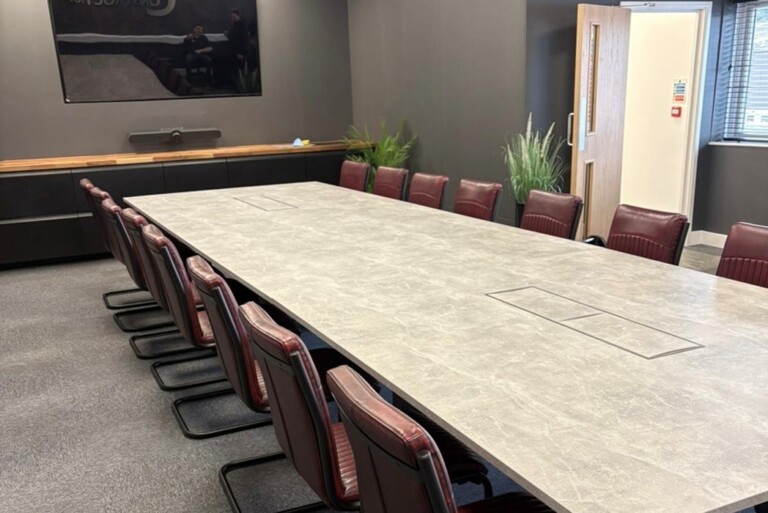
C3 Construction: A Bespoke Statement Boardroom Table
For C3 Construction in Whetstone, Leicester, we supplied a bespoke boardroom table designed to complement a contemporary office interior.
The project required a substantial executive table that would create a strong visual impression while remaining practical for everyday meetings.
The selected solution featured a concrete-effect tabletop from the Hawk Force range, supported by robust 100 × 100mm A-frame legs.
Integrated lift-out tiles provided convenient access to power and data connections, allowing meeting participants to connect their equipment without leaving cables across the table.
The project demonstrates how a bespoke boardroom table can combine distinctive design, practical dimensions and integrated technology.
See our C3 Construction bespoke boardroom table installation.
Howmet Aerospace: Creating a More Functional Boardroom
When Howmet Aerospace approached Leicester Office Furnishers, its existing meeting space was no longer meeting the company’s requirements.
The business wanted to divide a large meeting room into two separate areas, creating a dedicated boardroom for larger meetings and a smaller room for internal discussions.
We helped develop a layout that accommodated the different meeting requirements while improving the overall appearance of the space.
The boardroom included a new table with integrated lift-out power access, contemporary meeting chairs and bespoke storage and presentation units.
The result was a more functional meeting environment with improved facilities for visitors and video conferencing.
You can explore the completed project in our Howmet Aerospace office refurbishment case study.
Elmleigh: A Barrel-Shaped Executive Boardroom Table
At Elmleigh’s office in Hinckley, Leicester Office Furnishers supplied a large barrel-shaped boardroom table from Elite.
Finished in oak with black accents, the table was selected to complement the decorative panelling and create a professional executive meeting environment.
The project also included additional meeting room furniture, including oak-topped trumpet-base tables.
This installation highlights the visual impact that table shape, materials and finishes can have on a boardroom.
See our Elmleigh office furniture project.
What Else Should You Consider When Buying a Boardroom Table?
Once you’ve determined the appropriate table size and shape, several other features are worth reviewing before making your final decision.
Cable Management and Integrated Power
Modern meetings frequently involve laptops, presentation screens and video conferencing.
Integrated power modules, cable ports and concealed cable routes can keep the boardroom organised and reduce the need for trailing cables.
When specifying a table, check whether power and data connections are included or supplied as optional accessories.
Table Materials and Finishes
The finish of your boardroom table can influence the entire appearance of the room.
Popular options include:
- Oak and wood-effect finishes: Provide a warm, traditional appearance.
- Walnut finishes: Often chosen for executive boardrooms and premium interiors.
- White and light finishes: Can create a bright, contemporary environment.
- Grey and concrete-effect surfaces: Well suited to modern or industrial-style interiors.
- Laminate finishes: Available in various colours and typically practical for everyday cleaning.
The chosen finish should complement existing flooring, storage, wall colours and meeting chairs.
Choosing Suitable Boardroom Chairs
The table and chairs should always be considered together.
A boardroom table may technically accommodate twelve chairs, but if the chairs are particularly wide, the arrangement may feel overcrowded.
Consider chair width, armrests, seat height and the amount of space required to move in and out.
Our boardroom chairs include contemporary and executive seating options in a variety of materials and configurations.
Video Conferencing and Presentation Equipment
If your boardroom is regularly used for online meetings, consider where cameras, microphones and display screens will be positioned.
A very long table can make it difficult for participants at opposite ends to be seen or heard clearly without suitable audio-visual equipment.
The shape of the table can also affect sightlines to wall-mounted screens.
Planning these details before purchasing furniture helps avoid expensive adjustments later.
Delivery and Installation
Larger boardroom tables can be heavy and may arrive in multiple sections.
Before ordering, consider access to the building, staircases, lifts, door widths and whether the table needs to be assembled inside the room.
For bespoke or particularly large installations, professional delivery and fitting may be necessary.
Common Mistakes to Avoid When Choosing a Boardroom Table
Even a high-quality boardroom table can become impractical if the size or layout is wrong.
Some of the most common mistakes include:
- Choosing a table that is too large: Leaving insufficient space for chairs, doors and movement.
- Overestimating seating capacity: Assuming everyone can sit comfortably based only on the manufacturer’s advertised number of seats.
- Ignoring chair dimensions: Selecting wide executive chairs without checking available elbow room.
- Forgetting about technology: Overlooking power access, cable management and video-conferencing equipment.
- Selecting the wrong shape: Choosing a table that doesn’t complement the dimensions of the room.
- Overlooking other furniture: Forgetting that cupboards, presentation equipment and refreshments stations also require space.
- Not considering future needs: Buying a table that cannot accommodate expected changes in meeting requirements.
Measuring your space carefully and reviewing the complete furniture arrangement can help avoid these problems before installation.
Find the Right Boardroom Table with Leicester Office Furnishers
Choosing the right boardroom table size is about balancing seating capacity, available floor space and the way your business uses its meeting rooms.
A compact round table may be ideal for a small team, while a larger rectangular or barrel-shaped design can provide the space and professional appearance needed for executive meetings.
Whatever your requirements, it’s important to look beyond the table dimensions and consider chairs, circulation, technology and the wider office environment.
At Leicester Office Furnishers, we supply a comprehensive range of meeting and conference furniture, including standard and bespoke boardroom tables, meeting chairs and complementary office furniture.
Our team can also assist with furniture selection, space planning, delivery and installation, helping you create a boardroom that looks professional and works comfortably for everyone using it.
Frequently Asked Questions
What is the standard size of an eight-person boardroom table?
An eight-person rectangular boardroom table is often approximately 2400–2800mm long and 1000–1200mm wide. However, the exact dimensions depend on the shape of the table, chair sizes and whether people can sit comfortably at both ends.
What size boardroom table do I need for ten people?
A table measuring approximately 3000–3400mm in length may be suitable for ten people, depending on the seating arrangement. Wider executive chairs or additional space for laptops and documents may require a larger table.
How much space should you allow per person at a boardroom table?
Allowing approximately 600–750mm of usable table edge per person is a common starting point. For more spacious executive arrangements, 750–900mm may be preferable, particularly when using larger chairs.
How much space should be left around a boardroom table?
A preliminary allowance of around 900–1200mm can help accommodate chairs and movement, but the exact clearance depends on chair dimensions, door openings, circulation and accessibility requirements. Busy walkways may need more room, and the layout should be assessed against applicable building and fire safety requirements.
What is the best shape for a boardroom table?
Rectangular tables are often practical for larger, formal meetings, while oval and barrel-shaped tables create a softer executive appearance. Round tables can work well for smaller, collaborative discussions. The best choice depends on the room and the number of people attending.
Can a boardroom table be made to a custom size?
Yes. Bespoke boardroom tables can be manufactured to specific dimensions, shapes and finishes. This can be useful for unusually shaped rooms, larger seating arrangements or businesses requiring integrated power and technology.
What size room do I need for a twelve-person boardroom table?
A twelve-person rectangular table might measure approximately 3600–4200mm in length. If a 4000 × 1400mm table is selected and an illustrative 1200mm clearance is allowed on all sides, the resulting planning footprint would be 6400 × 3800mm, excluding additional room features. The final layout must account for chairs, doors, storage and circulation.
Are round or rectangular boardroom tables better for small rooms?
Both can work well depending on the room’s shape. Round tables can create a comfortable face-to-face meeting environment, while rectangular tables may fit more efficiently into narrow rooms or spaces where furniture needs to sit along a particular axis.